Orientation for a Cosmetic Housing
Eliminating layer stair-stepping and support scarring across high-visibility exterior surfaces through calculated tilt angles and seam displacement.
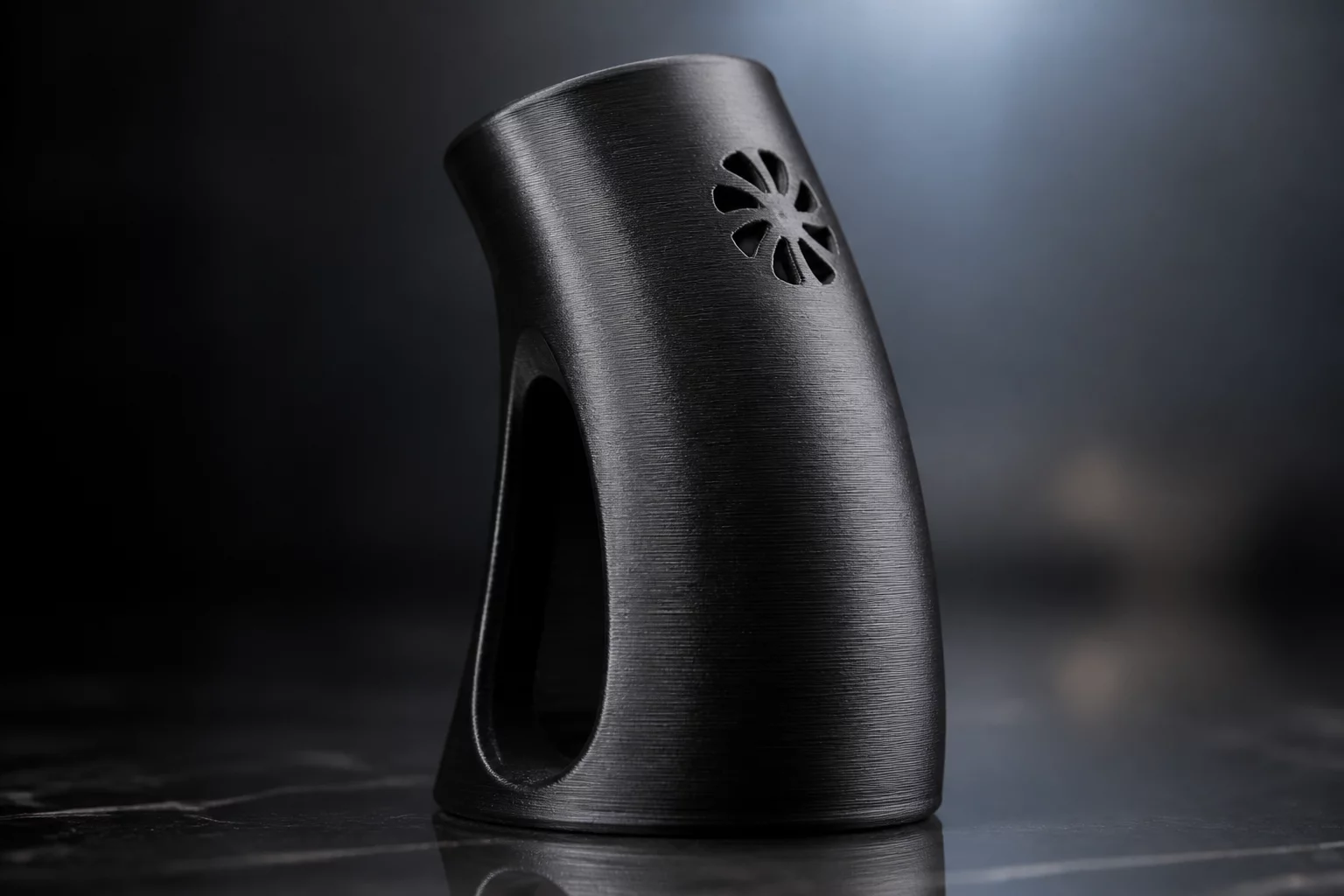
Fabricating consumer-facing enclosures requires an uncompromising approach to surface definition. Flat placement on the print bed causes severe stair-stepping across low-angle domes, instantly revealing layer stratification to the naked eye. In contrast, 3D print orientation decisions aimed at visual perfection must navigate how vertical rotation affects support generation and perimeter integrity.
When an enclosure features flowing organic contours, slight variations in spatial tilt drastically alter surface reflectivity. Raising the enclosure to a near-vertical attitude smooths curved upper surfaces by aligning them tangent to the Z-axis. However, this orientation shifts mechanical vulnerabilities toward structural snap joints, creating classic part orientation trade-offs that demand deliberate toolpath compromises.
Primary Rule: Concealing Support Scars on Secondary Planes
Orienting the primary cosmetic face at a 65-degree incline forces overhangs toward hidden interior cavities, ensuring that support contact scars remain confined to non-cosmetic interior ribs rather than visible exterior shells.
Surface Finish Diagnostics and Contour Preservation
During an extensive PrusaSlicer orientation review, toolpath previews reveal exactly where shallow gradients will exhibit layer stepping. By monitoring sliced line widths and layer transitions across curved walls, engineers can predict contour degradation before extrusion begins.
- Angling curved top facades past 55 degrees from horizontal eliminates coarse terrace steps across broad radii.
- Confining support structures strictly to interior snap fits and fastener bosses preserves pristine class-A exterior surfaces.
- Relocating perimeter start points to internal corners prevents seam pimples from disrupting continuous light reflections.
Balancing Print Time Against Aesthetic Precision
Vertical and steep angled builds naturally increase the total layer count, extending cycle duration across single-piece production runs. Implementing adaptive variable layer heights alleviates this time penalty by extruding thinner bands on delicate radii and thicker bands along flat vertical perimeters, achieving production-grade aesthetics efficiently.
Dr. Julian Vance
Additive SpecialistRotating the cosmetic enclosure at an elevation angle of 65 degrees drastically improved reflection homogeneity along the top radius. Isolating support attachment interfaces strictly to the perimeter boundary lip completely removed downstream hand-sanding bottlenecks.