Maximizing Z-Axis Strength
Engineering strategies to counteract material anisotropy and prevent premature delamination under complex load vectors.
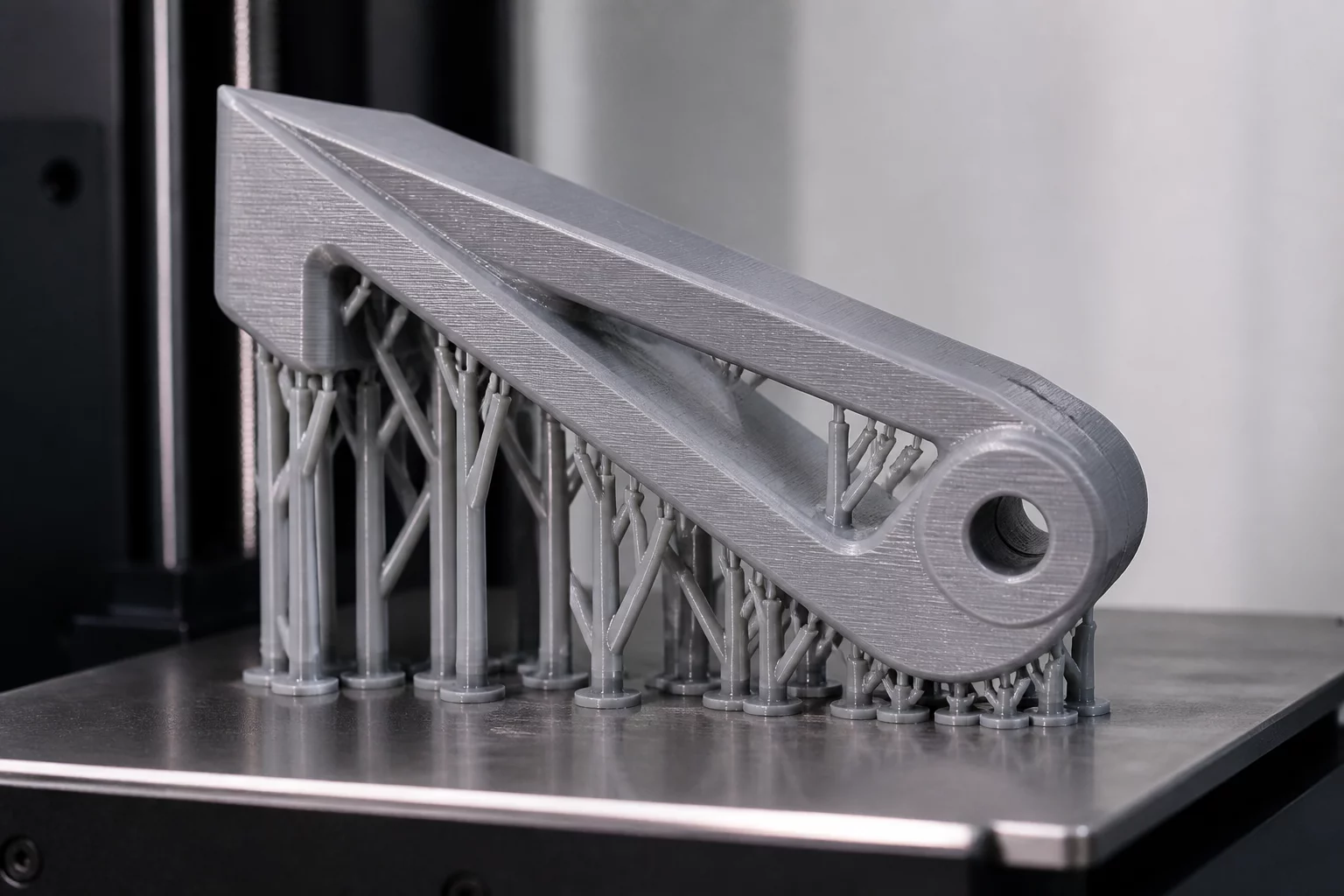
Interlaminar bonding remains the inherent weak link in extrusion-based additive manufacturing. When tensile loads pull directly perpendicular to layer lines, parts frequently experience catastrophic failure at values twenty to fifty percent below their nominal horizontal yield ratings. Making sound 3D print orientation decisions is crucial for aligning mechanical stress vectors with continuous filament extrusions rather than vulnerable thermal interfaces.
When pure horizontal alignment is impossible due to geometric constraints, complex overhangs, or internal cavities, angular reorientation provides an effective middle ground. Canting a functional part at forty-five degrees transforms direct tensile cleavage into a distributed combination of compression and shear across multiple adjacent layers. Conducting a thorough PrusaSlicer orientation review enables engineers to preview the internal infill vectors and ensure that perimeters cross critical stress concentration planes smoothly.
Core Principle of Mechanical Stress Redistribution
Orienting structural members at an angle between 35 and 55 degrees engages neighboring toolpaths in composite shear resistance, effectively increasing tensile failure thresholds by over thirty percent compared to pure vertical orientation.
Balancing Structural Integrity Against Surface Resolution
Evaluating part orientation trade-offs requires weighing structural load capacity against support generation and surface stair-stepping. An inclined part introduces support interfaces on down-facing walls, requiring careful consideration of support contact distances and post-processing tolerances to keep critical mating surfaces clean.
- Set hotend temperatures toward the upper threshold of the polymer range to encourage deep polymer chain diffusion across previous layers.
- Increase extrusion width to 120-130% of nozzle diameter, expanding the physical contact area between vertically stacked beads.
- Reduce active part cooling fan speeds across heavy load-bearing volumes to prevent premature glass transition quenching.
- Align perimeter seam placements away from high-stress fillets and notch roots to avoid creating localized mechanical fracture origins.
Optimizing Slicer Toolpaths for Isotropic Performance
Beyond build plate rotation, toolpath parameters within the slicer play a decisive role in mechanical longevity. Combining dense gyroid or 3D honeycomb infill structures with nested perimeters creates multidirectional reinforcement ribbons. These interwoven tracks absorb cyclic deflection forces and prevent micro-fractures from propagating along individual layer seams.
No peer assessments logged yet. This could be your first comment.