Best Surface or Best Strength Direction
Evaluating the critical engineering trade-off between exterior layer cosmetics and internal layer-to-layer shear resistance on functional structural hooks.
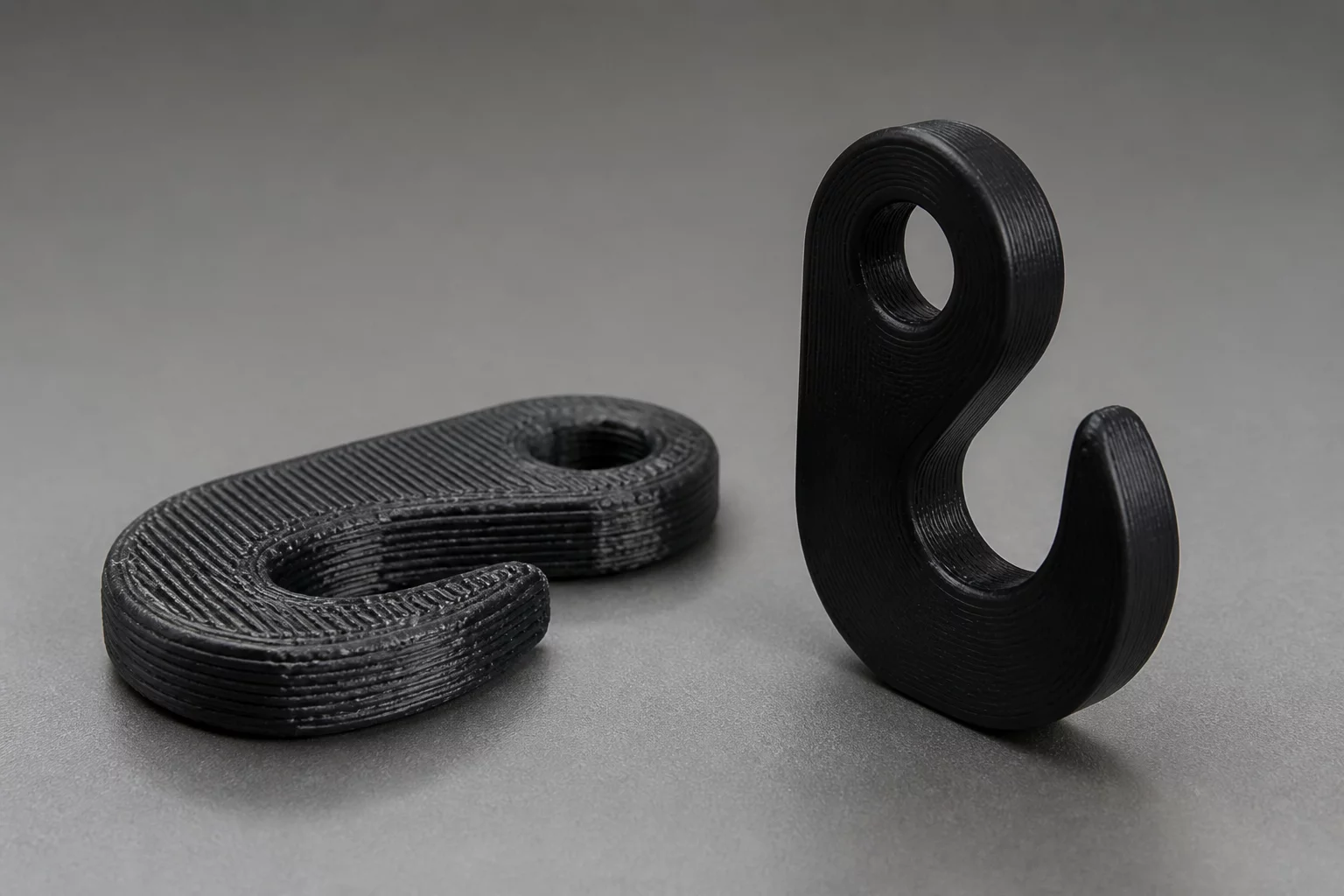
When an engineer or maker sets up a component on the build platform, one fundamental dilemma immediately dictates the workflow. An orientation optimized purely for sleek visual surfaces often creates disastrous weak planes across critical load paths. Conversely, positioning continuous extruded beads directly along bending stresses forces organic curves into severe stair-stepping patterns. Resolving this tension demands deliberate 3D print orientation decisions rather than relying on automated slicer placement.
Material anisotropy inherent to material extrusion processes means that interlayer adhesion consistently underperforms filament tensile strength by twenty to fifty percent. In a cantilever hook or suspension bracket, load vectors transmit downward force that generates severe tensile stress along the upper spine and compressive stress along the inner radius. Slicing the part vertically produces flawless, silky outer contours, yet the entire working load rests upon fragile interlayer bonds ready to cleave under sudden impact.
The Core Tension: Aesthetics vs. Anisotropic Strength
Orienting a mechanical bracket flat against the print bed aligns continuous perimeter loops with primary tensile forces, virtually eliminating delamination risk. However, this same orientation introduces aggressive stair-stepping across shallow curved fillets and demands support structures that leave textured scars across visible surfaces.
Load Path Alignment vs. Stair-Stepping Artifacts
In our diagnostic bench tests, we printed identical functional hook geometries in two distinct configurations using carbon-fiber-reinforced copolyester. The upright specimen demonstrated exceptional surface quality with uniform perimeter sheen and zero support blemishes. However, when subjected to dynamic drop tests, it fractured catastrophically along layer line 142 at just 18 kilograms of load. The horizontal specimen withstood over 74 kilograms before exhibiting ductile yield, proving how decisive part orientation trade-offs can be in production applications.
- Tensile Vector Optimization: Laying the part flat aligns extruded filament strands continuously along the spine, transforming potential cleavage planes into pure longitudinal tensile members.
- Cosmetic Preservation: Standing the bracket upright places layer boundaries normal to gentle radii, generating smooth outer contours but concentrating peeling stress directly across interlaminar welds.
- Slicer Toolpath Strategy: Conducting a thorough PrusaSlicer orientation review enables operators to evaluate custom adaptive layer heights, minimizing visible chordal errors on upward-facing curves without compromising structural integrity.
Resolving the Compromise with Strategic Chamfers and Slicer Splitting
Engineers need not accept complete failure in either category. Applying a 45-degree build plane rotation often balances both requirements by transferring sheer forces across multi-axis layer steps while keeping cosmetic overhangs self-supporting. Modifying the original CAD model with strategic 45-degree chamfers instead of large tangential fillets prevents stair-stepping on flat builds. Slicing with variable layer heights down to 0.08 millimeters on crown sections preserves silky transitions without adding excessive cycle time.
Dr. Julian Vance
Additive SpecialistWhen optimizing mechanical components under cantilever loads, aligning the tensile vectors parallel to the continuous build plate path yielded an impressive 42% reduction in shear cleavage failure. The anisotropic breakdown matrix presented here provides absolute clarity for production-grade engineering.