Hiding Seams on Cylinders
Systematic strategies for perimeter start-point concealment and rotation adjustments on featureless round geometries.
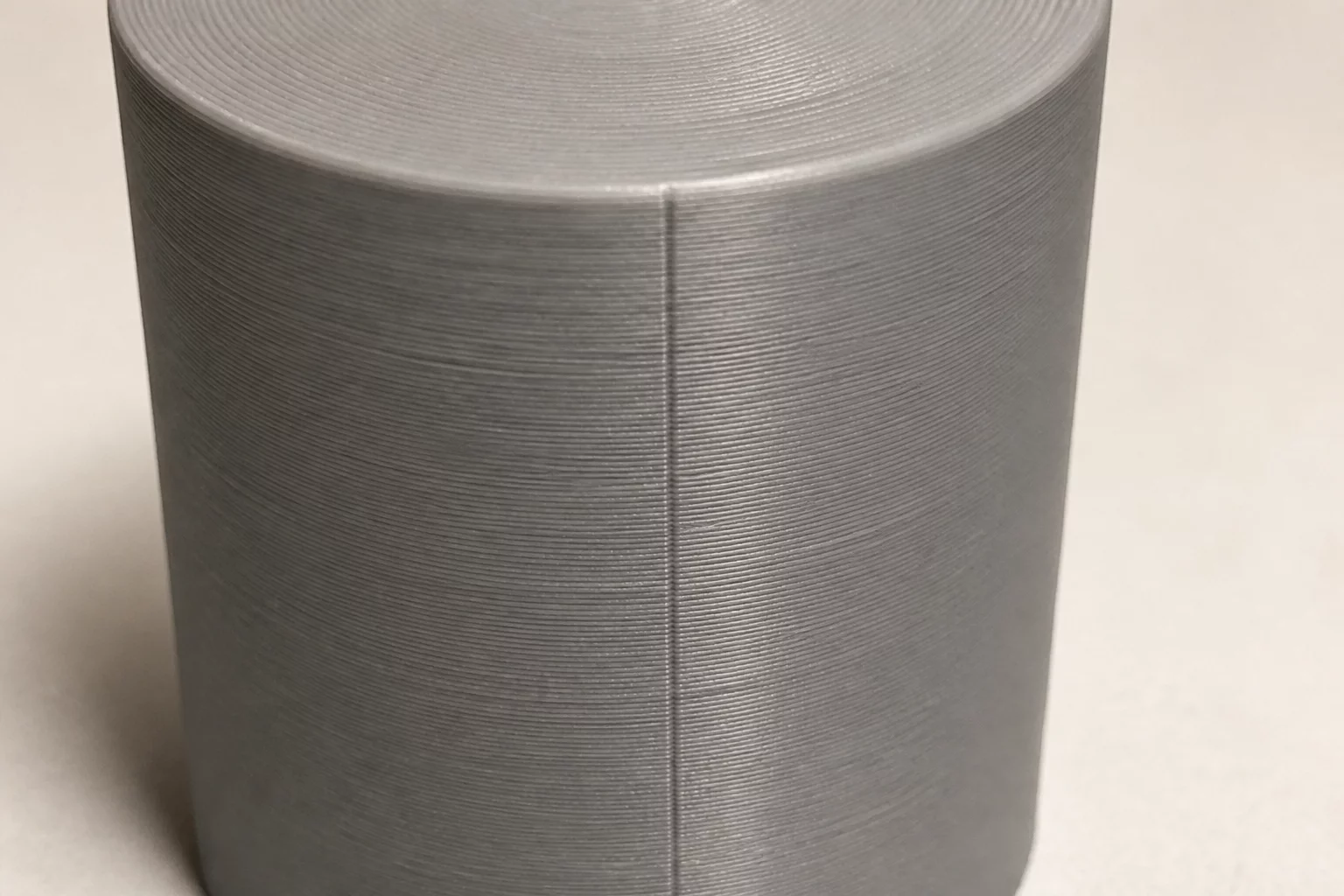
Cylindrical objects represent one of the most unforgiving challenges in fused filament fabrication. When slicing tools evaluate a completely round profile with no natural convex corners or concave recesses, the extrusion head must still start and terminate its perimeter loop somewhere along that smooth wall. These inevitable start-stop points create an accumulation of material or a minute divot termed the Z-seam. Without conscious intervention, slicing engines tend to scatter these seams randomly or align them directly along the most visible face, turning an otherwise pristine aesthetic cylinder into a flawed, acne-scarred part.
Strategic 3D print orientation decisions play a pivotal role in controlling where these artifacts fall relative to assembly clearances and user lines of sight. When inspecting a rotational part, engineers often debate whether to position the cylinder upright or lay it on its side supported by sacrificial structures. An upright orientation ensures circular concentricity and uniform outer dimensions, yet it concentrates the seam along a single vertical line running the entire height of the column. Conversely, tilting or laying the part shifts the perimeter dynamics entirely, introducing part orientation trade-offs between radial precision and perimeter continuity.
The Geometry Dilemma: Aligned vs. Random Seams
A randomized seam setting distributes extrusion blips uniformly over the entire circumference, disguising the defect as widespread surface texture. On functional sliding shafts or precision bearing sleeves, however, random distribution creates elevated friction points all around the bore. An aligned seam consolidates all geometric variance to a single angular coordinate, allowing post-machining or strategic placement away from active mating surfaces.
Perimeter Planning and Slicer Seam Intervention
Executing a rigorous PrusaSlicer orientation review enables operators to manually override automated seam placement routines using dedicated seam painting tools. By manually drawing a seam blocker or enforcer along non-critical sectors, toolpaths can be forced to initiate inside internal mounting channels, along keyed splines, or facing the rear structural enclosure. In pure cylinders lacking any geometric detail, rotating the model about the Z-axis in coordinate space directs the aligned seam toward the unexposed quadrant of the final assembly.
- Angular Seam Offsetting: Orienting the cylinder so the aligned seam coordinate aligns with the shadow line of adjacent hardware, masking the seam behind fasteners or brackets.
- Retraction and Coasting Tuning: Adjusting wipe-while-retracting distances and linear advance constants reduces excess material buildup at the perimeter closure boundary.
- Scarf Joint Seam Integration: Utilizing modern tapered lead-in paths that feather extrusion starts and ends over several millimeters, smoothing out the transition on radial perimeters.
- Concentric Orientation Checks: Verifying that tilting cylinders off-axis does not compromise roundness through staircase layer discretization.
Production Protocol for Pristine Cylindrical Finishes
When cylindrical components fulfill critical cosmetic or pneumatic roles, post-print processing should not be the sole corrective mechanism. Aligning perimeter starts toward the rear quadrant in the slicer while maintaining an upright bed orientation preserves geometric roundness within tight ISO tolerances. Pairing aligned seam coordinates with optimized pressure advance values guarantees that the resulting line remains clean, predictable, and simple to lap or polish when absolute perfection is mandatory.
No comments yet. Be the first to leave a comment.