Visible Surfaces: Eliminating Staircase Artifacts and Interface Scars
A systematic directive on orienting primary aesthetic faces, curved cosmetic enclosures, and presentation textures relative to build planes to eliminate layer discretization and support pitting.
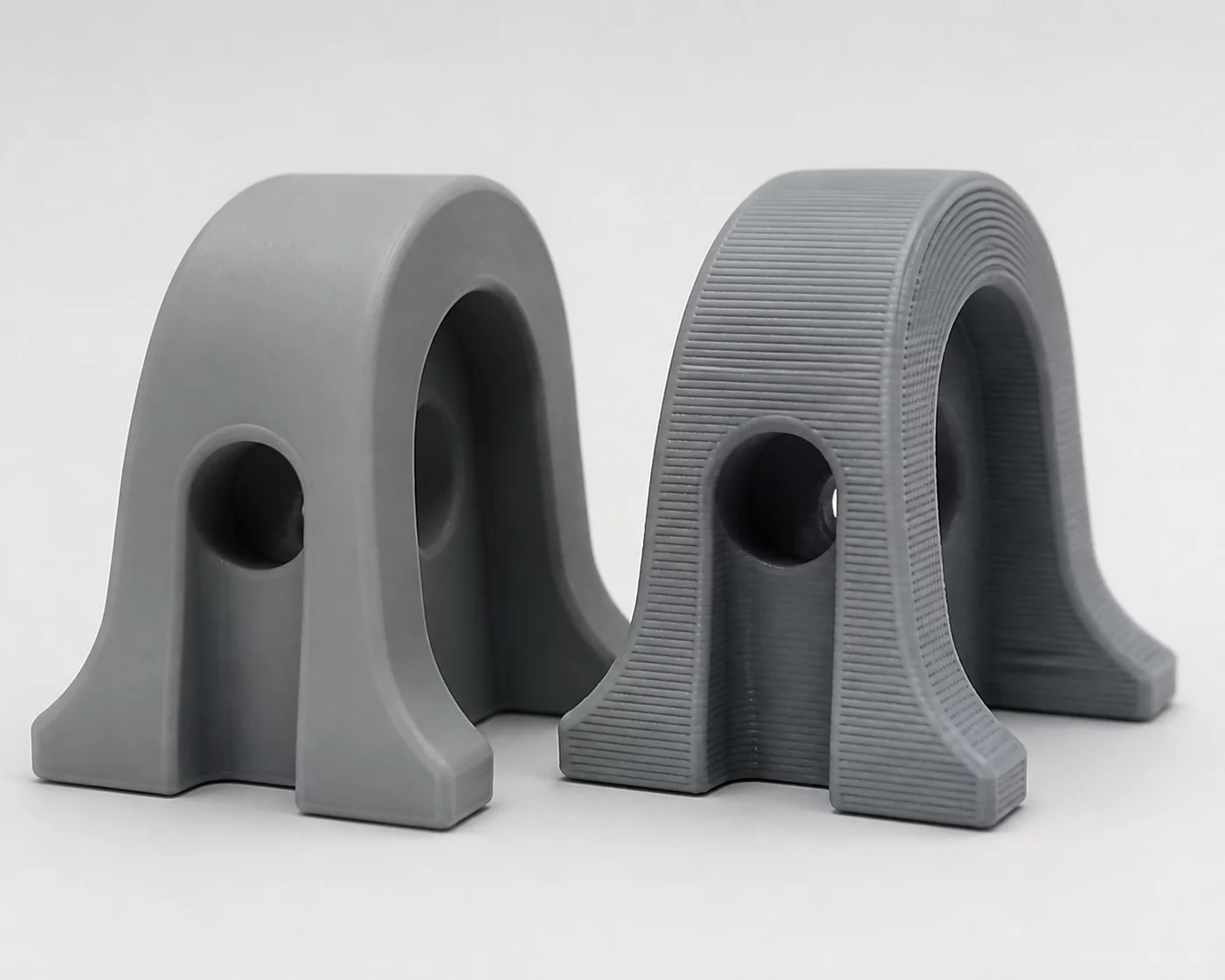
The Geometry of Visual Quality in Additive Manufacturing
Surface aesthetics in additive manufacturing depend directly on the angle between model normals and the build platform. Making disciplined 3D print orientation decisions determines whether an external shell displays pristine satin curves or objectionable topographic stair-stepping.
When navigating part orientation trade-offs, industrial designers frequently encounter shallow organic contours that slice poorly when laid flat on the build plate. As layer lines traverse gentle curves, layer thickness produces pronounced visual contour rings. Conducting a methodical PrusaSlicer orientation review enables practitioners to angle cosmetic planes steeply, compressing visible layer steps into micro-textures that remain virtually invisible to the naked eye.
Aesthetic Orientation Rule
Isolate primary cosmetic faces from direct support contact points whenever possible. Orient high-visibility surfaces either upright at steep draft angles or directly parallel to continuous perimeter toolpaths.
Mitigating Support Scars and Staircase Layer Discretization
Every support interface leaves micro-pitting, drooping filament loops, or witness marks that demand aggressive manual finishing. Positioning crucial presentation faces away from support generation zones preserves pristine as-printed finishes while keeping post-processing costs manageable.
- Steep Wall Projection: Incline shallow curved top faces beyond 45 degrees to narrow horizontal step spacing.
- Concealed Support Scaffolding: Direct necessary support structures toward internal ribs, hidden cavities, or non-visible mating features.
- Adaptive Layer Slicing: Apply finer slice heights to tight radial features during slicing while retaining standard speeds on straight walls.
In-depth PrusaSlicer orientation review practices also incorporate painted support blockers across outward fillets and embossed logos, guaranteeing that sacrificial structures only attach to internal undercuts.
Technical Discourse & Peer Reviews
No technical reviews submitted yet. Be the first practitioner to contribute observations on this directive.
Submit Additive Insight or Peer Review
All technical contributions are peer-moderated in accordance with ISO/ASTM standards.