Interface Quality in Mating Assemblies
Protecting contact planes, bearing seats, and interlocking joints from support debris while preserving high-precision dimensional tolerances across multi-component builds.
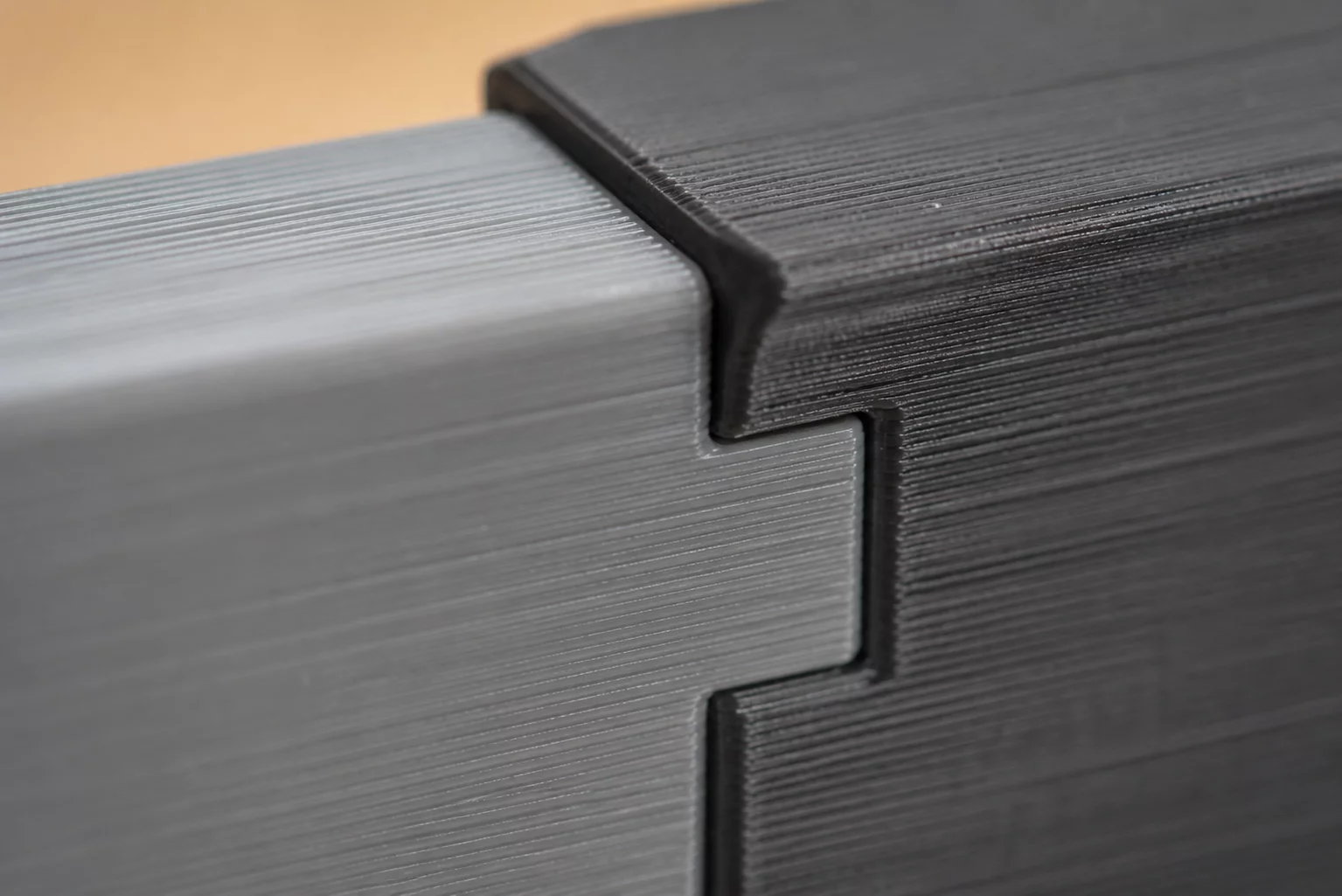
Engineering Fundamentals of Interface Quality Decisions
Mating components in functional mechanical assemblies demand pristine surface contact. In high-precision additive manufacturing, making informed 3D print orientation decisions directly governs whether interlocking joints slide smoothly or bind during insertion. Any surface that mates against another component must retain its true nominal dimensions without sagging, droop, or localized layer widening.
When evaluating part orientation trade-offs, engineers must never allow sacrificial support interfaces on precision mating faces. A comprehensive PrusaSlicer orientation review helps isolate critical sliding surfaces, repositioning the component so that contact lands face upward or print directly along the horizontal XY raster plane where motion control produces optimal accuracy.
Key Decision Rule
Always direct support structures toward non-functional exterior facades rather than sliding joints, dowel pins, or gasket channels. Preserve contact interface planes through self-supporting angles or vertical layer slicing.
Preserving Joint Clearances and Eliminating Seam Artifacts
Every joint configuration introduces distinct tolerances. Dovetails, sliding guides, snap fits, and tongue-and-groove connections react differently to layer deposition anomalies. A single unaligned start-stop perimeter seam inside a guide rail can jam an entire mechanism.
- Parallel Contact Alignment: Keep flat mating flanges strictly parallel to the build sheet or fully vertical to avoid stairstep interference.
- Seam Suppression: Force perimeter start points onto non-critical external chamfers rather than internal sliding tracks.
- Overhang Angle Retention: Ensure mating chamfers remain at 45 degrees or steeper relative to the build plate to prevent saggy perimeter loops.
- Thermal Shrinkage Compensation: Orient male and female interface parts in matching coordinate planes to equalize thermal contraction rates across both pieces.
During the final PrusaSlicer orientation review stage, inspect individual perimeter layers around sliding slots using the preview visualizer. Verify that the extrusion line width does not create unexpected corner bulging on internal corners.
Technical Discourse & Peer Reviews
No comments yet. Be the first to leave a comment.
Submit Additive Insight or Peer Review
All technical contributions are peer-moderated in accordance with ISO/ASTM standards.